Tailoring and suiting editorial with AI: lapels, shoulders, drape and fit words
How to word a suit for an AI image: lapel shape, shoulder line, drape, pinstripe and wool, buttons and cuffs that hold, and where AI tailoring still fails.
A suit is the one garment everybody can judge at a glance without knowing why. People who could not name a single seam will still say that a jacket looks cheap, that the shoulders are wrong, that the trousers pool at the shoe. An image model has the same instinct for the average suit and very little for a specific one. Ask for a man or a woman in a suit and you get a stock photo of a suit: a dark jacket, a white shirt, a vague lapel, a body that fits nobody in particular.
This post is a vocabulary for tailoring, written for art direction rather than for a tailor. It covers the parts of a jacket that carry the look (lapel, shoulder, button stance, cuff), the cloth that carries the mood (wool, pinstripe, flannel), the fit words that change the whole silhouette, and an honest list of what still breaks. The model on this page is fictional: Corinne Adeyemi, invented for this article, a woman of legal age with cropped dark hair who wears everything below.
Start with the shoulder, because everything hangs from it
On a real jacket the shoulder decides the silhouette, and in an image it is the first thing the eye reads. Name it. A natural shoulder follows the body with soft padding and reads relaxed and modern. A structured shoulder is sharper, with a straight, slightly raised line that makes the torso look built. A roped sleeve head adds a small ridge at the seam, and a wide, padded line gives the broad, dramatic outline of an old film. Say where the sleeve seam sits too: at the edge of the shoulder bone for a clean fit, dropped below it for a deliberately oversized look.
Without a word for it the model picks one at random per frame, and your suit changes character between images. If you are building a set, repeat the shoulder phrase word for word in every prompt.
Lapels and button stance: the face of the jacket
Lapels frame the face, so mistakes there are the most visible. The three shapes worth knowing are notch (the everyday business cut, with a small step where collar meets lapel), peak (the lapel points up and out, formal and assertive, the usual choice for double-breasted jackets) and shawl (one smooth curve with no notch, the dinner jacket shape). Pick one and say it. Then say how wide: slim, medium or wide, and where it ends, which is the button stance. A high stance reads sharp and classic, a low one reads long and relaxed.
- Single-breasted: one or two buttons, a clean vertical line. The easiest to keep correct, since there is little to count.
- Double-breasted: two columns of buttons and a wide overlap. Strong in print, and the one where buttons most often multiply or go missing. Name the number you want in words and look at the result closely.
- Open or buttoned: a jacket worn open shows the shirt and the lining, which is more to get right. A buttoned jacket is a simpler shape and a good first test.
Cloth: pinstripe, flannel and the way wool falls
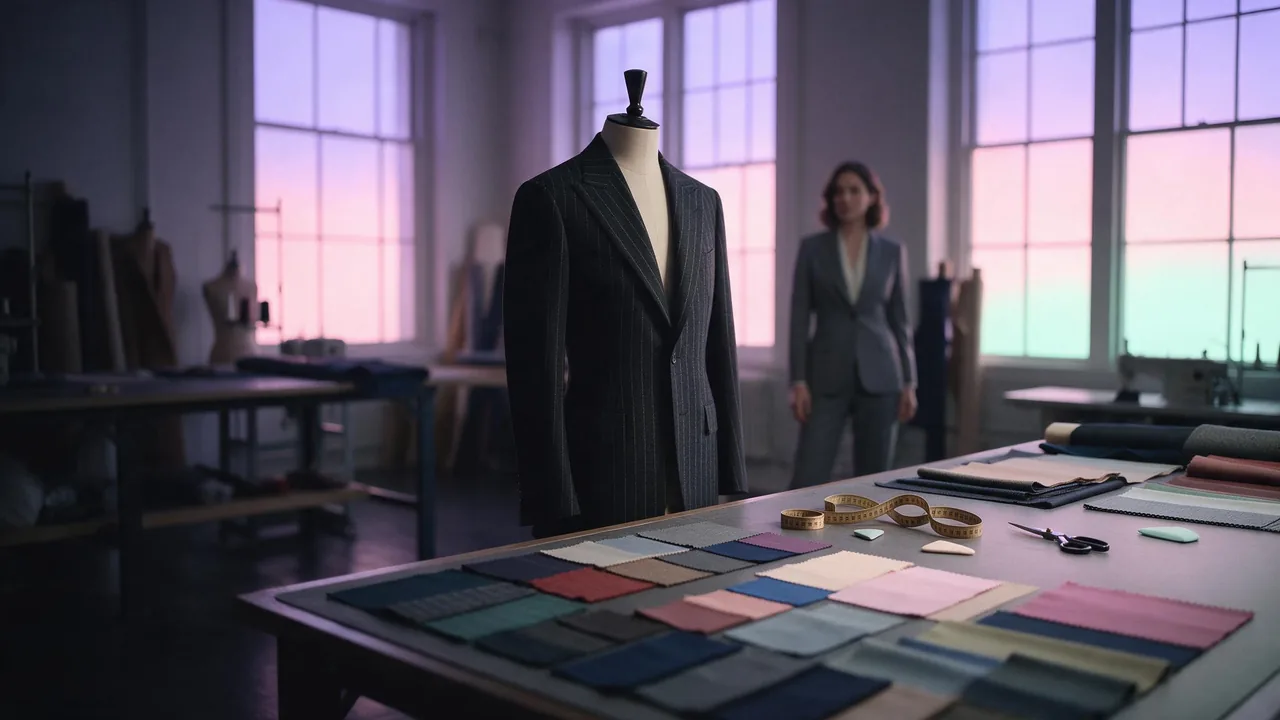
Tailoring is texture and line at once. Wool is the default, but the kind matters. A worsted wool is smooth and fine, with a faint sheen and crisp edges. Flannel is softer and napped, matte, with a heavier fall. Tweed and herringbone are rougher and visibly woven. Say the cloth the way a buyer would and the surface follows. For a close look at weave itself, fabric texture close-ups goes deeper; here the question is how cloth behaves when it is cut into a jacket.
Pinstripe deserves its own warning. A stripe is a rule the whole garment must obey: the lines run straight down the front, curve with the chest, and meet across the seams. Image models keep the idea of stripes and lose the obedience, so stripes bend, fade out at the sleeve or change spacing from one panel to the next. Ask for a thin, evenly spaced pinstripe in a named tone (pale grey on charcoal is the classic) and keep the camera at a distance where the stripe is a texture rather than a measurement. When the stripe is the subject, step in, accept that it will not match perfectly across the lapel, and choose the frame where the break is least visible.
Fit words that change the whole silhouette
Fit is a handful of words, and each one moves the body of the picture. Slim and tailored follows the torso and tapers at the waist. Relaxed and boxy hangs straight from the shoulder with room in the chest. Oversized pushes the shoulder out and lengthens the jacket, the usual pairing with wide trousers. Cropped stops at the hip. For trousers, name the leg (straight, tapered, wide) and the break, which is how the hem meets the shoe: a clean line with no fold, a soft single fold, or a deliberate pool of cloth. Drape is the word for how the fabric falls when the body moves, and it is the cheapest way to make a garment look worn rather than posed. Ask for the jacket to fall straight from the shoulder with a soft vertical fold at the hip, and the stiffness disappears.
Fashion editorial photograph, three-quarter view of a woman of legal age with cropped dark hair in a charcoal worsted wool double-breasted suit, thin evenly spaced pale-grey pinstripe, structured shoulder, wide peak lapels, horn buttons in two columns with the lower one fastened, wide straight trousers with a soft single break over black leather loafers, a white poplin shirt open at the collar. She stands in a high-ceilinged tailor's atelier, soft lilac window light from the left, a rail of garment bags blurred behind, crisp focus on the lapel and the front of the jacket, 16:9.Buttons, cuffs and the small things that warp
Tailoring lives in details that repeat in pairs, which is the pattern models are worst at. Two sleeves should end in matching cuffs, with the same number of buttons set the same distance apart; real jackets often show a little of the shirt cuff beyond the sleeve, and that is a second edge to keep clean. The breast pocket should carry a flat welt, and a pocket square or a folded handkerchief is a gift to a prompt writer, because it is one small shape of a named colour. Check these before you praise a frame:
- Count the sleeve buttons on both cuffs and compare them.
- Follow the lapel from the collar to the top button on both sides. Do the two edges mirror each other?
- Check where the jacket meets the hands. Fingers and cuffs tangle easily.
- Look at the trouser hem and the shoe line for a clean break.
- Follow one stripe or check from the chest to the hem. Does it stay straight?
For the metal and leather that finish a look, such as belt buckles, cufflinks and watch cases, see accessory shots without warped hardware.
Styling a suit on a fictional model
Once the suit is right, the styling decides the story. The same charcoal jacket reads as boardroom with a crisp shirt and a tie, as evening with a silk camisole and no shirt at all, and as casual with a knit polo and white sneakers. Treat the suit as one fixed garment and change only one thing at a time around it, with the same wording for the tailoring in every prompt. That is also the way to build a small set: a capsule wardrobe needs the jacket to be the same jacket in every frame, and a coat over a suit works when the tailoring is named before the coat is added. Keep the model fictional and of legal age, and give her one recurring detail, like cropped hair or a small gold earring, so the person stays recognisable between shots.
Where AI tailoring still fails
Be realistic about the limits. A model does not know how a jacket is cut, so it imitates how a cut jacket looks, and the imitation breaks on construction: a lapel that never meets the collar, a pocket that sits at a slant, a vent that appears on the wrong side, sleeves of different length, a lining that changes pattern. Stripes and checks will not match across seams. Buttons and buttonholes drift. A suit worn with arms crossed or hands in pockets multiplies the chances of a mistake, because cloth, fingers and cuffs overlap. Text on a label, a brand stitch or a woven tag will not be legible, and a garment that must be an exact copy of a real suit is outside what an image model promises.
Use these pictures as fictional fashion visuals for mood, concepts, mood boards and lookbooks. A small local flaw may be worth an edit pass with one of the edit models on the models page; look at the edit as closely as the original, since it can add a fresh mistake. The price shows on the Generate button before you run, so test the shoulder and the lapel cheaply, then spend on the final frame in the studio.
Questions
How do I get a lapel that looks right in an AI image?
Name its shape (notch, peak or shawl), its width and the button stance, and keep the camera close enough that the lapel is a clear part of the frame. Then check that both edges mirror each other.
Why do pinstripes bend or fade out?
A stripe has to obey the whole garment, and image models keep the idea of stripes more than their discipline. Ask for a thin, evenly spaced stripe in a named tone and frame it so it reads as texture.
What fit words matter most for a suit?
Shoulder (natural or structured), jacket fit (slim, relaxed or oversized), trouser leg and the break at the hem. Repeat the same words in every prompt to keep a set consistent.
Can I generate an exact copy of a real suit?
No. Seams, buttons and stripes drift from frame to frame and labels will not read. Use suit images for concepts and mood, not as a copy of an existing product.