Pose and stance words for AI fashion models: standing, seated, walking
AI fashion model pose prompts that show the garment: standing, seated and walking words, weight, hands and gaze, plus the words that give stiff or broken limbs.
A fashion pose is not a mood, it is a job. A good one shows the sleeve, lets the hem fall, keeps the drape of the fabric readable and gets the face out of the way when the garment is the subject. Most AI fashion model pose prompts fail because they describe a feeling ("confident", "elegant", "sassy") and leave the body to chance. The model then picks the safest pose it knows: square to the camera, both arms hanging, a smile.
This is a word list, organised by what the body is doing. Use it the way a stylist talks to a model on set: short instructions about feet, hips, arms, chin and eyes. Every example is for a fictional adult model you invent, in ordinary, fully dressed fashion work.
Start with the feet and the weight
Everything in a standing pose follows from where the weight sits. Name it, and the hips, shoulders and spine arrange themselves; leave it out and you get the flat catalogue stance with both legs carrying equal load.
- "Weight on the back leg, front knee softly bent." The classic. It tilts the hips, shifts the shoulders the other way and gives a long skirt or trouser leg a natural diagonal.
- "One foot slightly in front of the other, toe pointing toward the camera." Reads as relaxed and makes a coat open naturally at the front.
- "Feet hip-width apart, weight even." Use it on purpose for a clean, symmetrical look of a tailored suit or a column dress.
- "Three-quarter turn, body angled away, face back toward the lens." A turned body slims the silhouette and shows the side seam, the pocket and the back of a sleeve.
Walking: describe one frame of the stride
Do not write "walking". Write the half second you want: "mid-stride, front heel just landing, back foot lifting, long coat swinging open". Walking is the best pose for movement in a hem, a pleat or a scarf, and the worst when the legs are left unspecified, because the model blends two steps into one extra limb. A single clear stride, seen from the side or slightly in front, is the reliable version.
Ask for the garment to move and the pose follows. "Wide-leg trousers swinging forward with the step" or "pleated skirt lifting slightly at the hem" tells the model what the frame is for. The street-style guide covers the camera and the city side of the same idea.
Seated: show the fabric, not the furniture
Seated poses are where legs and chairs get confused. Keep the furniture simple (a plain stool, a low bench, a wooden chair, steps) and give the legs one clear arrangement:
- "Seated on a plain stool, legs crossed at the knee, hands resting in the lap." Shows a skirt or trouser fall and the shoe on the top foot.
- "Perched on the edge of a low bench, knees together, feet angled to one side." Neat and tailored, and it keeps a long dress from bunching in the frame.
- "Sitting on the floor, one knee up, one arm resting on it." Good for relaxed denim, knitwear and wide trousers, as long as the hands are named.
- "Leaning back in a chair, one ankle over the other knee." Casual, but ask for the shoes to be visible, or the second foot disappears.
Hands and arms: give them a job
Hands break first, so never leave them unmentioned and never overload them. One clear instruction per hand is the rule, and the most reliable instructions are the ones that hide the fingers or give them a simple object:
- "One hand in a trouser pocket, thumb out." Opens the jacket on that side and shows the lapel.
- "Hand resting on the hip, elbow out." Makes a triangle of negative space that shapes the waist of a dress or a belted coat.
- "Fingertips touching the collar." Draws the eye to a neckline, a scarf or a shirt collar without a full hand in view.
- "Both hands holding the lapels closed." A clean way to show how a coat sits across the chest.
- "Arms relaxed at the sides, cuffs visible." For a pure sleeve shot: the hands just hang, and the cuff is the star.
Head and gaze: where the eyes go decides what we read
The face is a magnet. If the model looks into the lens, the viewer reads the person first and the clothes second. To make the garment lead, send the eyes elsewhere: "looking down and to the left", "gaze toward the horizon off frame", "chin lowered, eyes on her sleeve". A turned head with a visible jaw line also shows a collar or earring cleanly. Reserve direct eye contact for the one frame in a set that is meant to be the portrait.
Asking for the garment, not the face
When a piece is the point, tell the model what to feature, then pick a pose that serves that part. A short map:
- Sleeve: arm slightly away from the body, elbow softly bent, cuff in view. Add "wrist turned toward the camera" for a shirt cuff or a knit rib.
- Hem: a mid-stride or a small turn, one foot lifting, "hem swinging". Frame from the knees down to the waist.
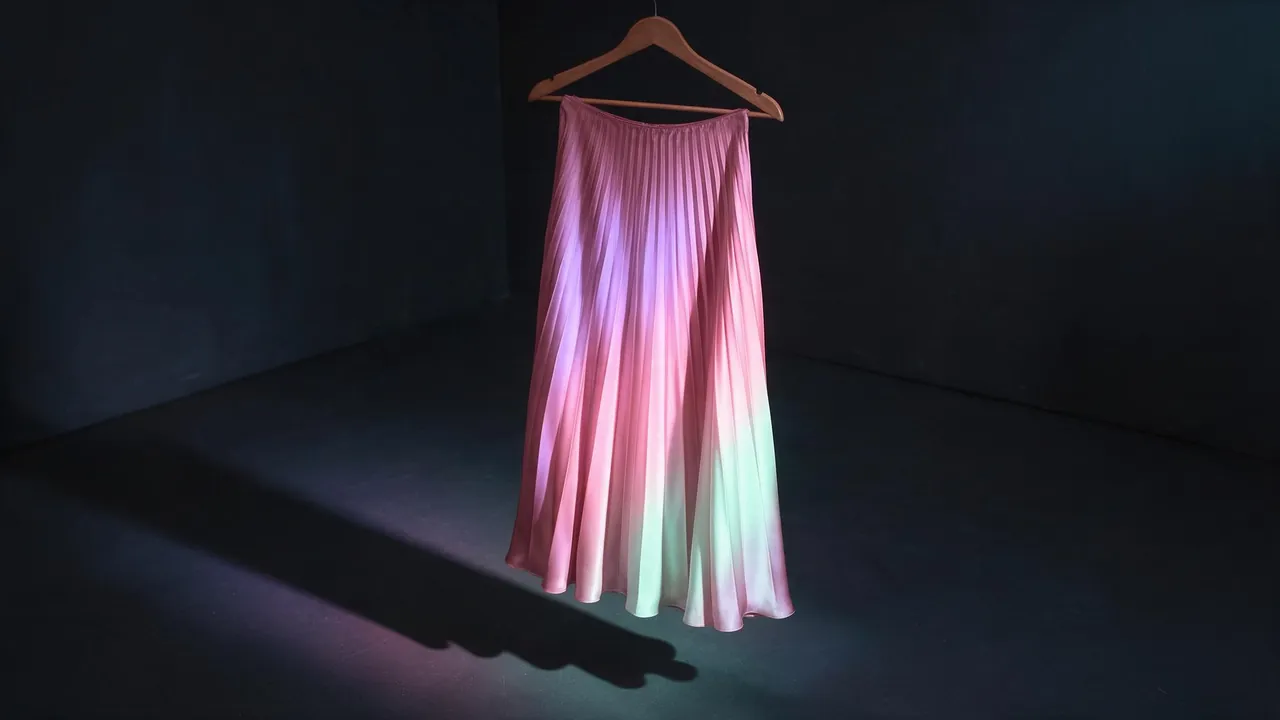
- Drape: a standing pose with weight shifted and one arm lifted, so a satin or crepe falls in long lines. Say "fabric falls in soft vertical folds".
- Back detail: "back to the camera, head turned over the shoulder, hair swept to one side".
- Waist and fit: hand on the hip, three-quarter turn, "belt clearly visible".
Fashion editorial photograph of a fictional adult woman, mid-stride on a pale stone floor, front heel just landing, back foot lifting, wearing a long pleated silk skirt in dusty rose that swings forward with the step and a plain ivory shirt with the cuffs visible. One hand relaxed at her side, the other tucked in a skirt pocket. Head turned away, gaze down and off frame, face soft and secondary. Cropped from the knees to the collarbone. Overcast soft light, 85mm, 4:5.Words that give stiff or broken limbs
Some pose words are traps. They are common in prompts and quietly unreliable:
- "Dynamic pose", "action pose", "dramatic pose". Vague energy becomes twisted torsos and legs at odd angles. Describe the actual position.
- "Crossed arms" plus "holding a bag". Two instructions competing for the same hands often yield extra arms.
- "Legs crossed" without saying standing or seated. The model may cross them mid-air or fuse them.
- "Looking over her shoulder" without a turned body. Produces a twisted neck. Ask for the shoulders to turn too.
- "Perfect posture", "model pose". These return the stiff stand-and-smile default. Name the weight shift instead.
- Three or more poses in one prompt. "Sitting, laughing, adjusting her hair, holding a coffee" asks for four actions. Keep one.
The honest limitation: even a precise pose will fail some of the time, and full-body frames of walking or seated figures fail most often. Plan for a few renders per pose. A faster model is enough to test the stance; each render shows its price before it runs, so spend on the keeper only. Pick models on the models page.
Keep the pose consistent across a set
A set needs variety without chaos. Pick three base poses (a standing weight shift, a walking stride, a seated one) and rotate the garments through them instead of inventing a new pose each time. For one invented face across a whole run, the one-model lookbook guide shows the reference-image method, and the art direction guide helps you plan the sequence. To put a particular garment on the model in the pose you chose, see virtual try-on on a fictional model. Start in the studio, and keep every person fictional and of legal age.
Questions
What are the best pose words for AI fashion models?
Name the weight and the limbs: "weight on the back leg, front knee softly bent", "one hand in a pocket", "mid-stride, front heel landing", "three-quarter turn". Concrete body positions beat moods like "elegant" or "confident".
How do I show the sleeve or hem instead of the face?
Pick a pose that serves that part: arm slightly away with the cuff in view for a sleeve, a mid-stride or small turn for a hem. Send the gaze off frame and crop below the chin if the garment is the subject.
Why do AI fashion models get broken hands and legs?
Vague words like "dynamic pose", too many actions in one prompt, or open spread fingers. Give each hand one simple job, prefer pockets and hips, and keep one action per frame.