A Y2K fashion editorial with AI: chrome, glitter and flash
One fictional model, five Y2K looks: chrome, glitter, low-rise and tinted lenses under a hard on-camera flash, with the same face kept in every frame.
Turn of the millennium style is loud on purpose. Chrome you can see your face in, glitter on the eyelids and the collarbones, jeans sitting a hand below the navel, tiny sunglasses in a colour no sunglasses need to be. The pictures that defined it were not careful either: a point-and-shoot camera, the flash fired straight on, red eyes fixed later or never. Ask an image model for "Y2K fashion" and you mostly get a clean, modern studio shot with a butterfly clip added. The clothes are half of the look. The camera is the other half.
So this post is a shot list, not an essay. Five looks, one model, one flash. The model is fictional and invented for this page: Odile Saar, an adult woman in her mid-twenties with a sharp platinum bob, dark brows and a gap between her front teeth. That last detail matters later, when we need to prove she is the same person in frame five as in frame one.
The flash comes first
Write the camera before the clothes. A soft, wrapped studio light will make the most outrageous outfit look like a catalogue from this year. The early 2000s look comes from one cheap light source sitting right next to the lens.
- Direct on-camera flash: say it in those words. Bright, flat light on the subject, the face slightly overexposed, a hard dark shadow just behind the figure on the wall.
- Falloff: the background drops fast into darkness, or stays as dim, warm room light if you add "slow shutter, ambient light behind". Pick one; mixing both by accident gives a muddy frame.
- The camera itself: "compact digital camera, early 2000s" or "disposable film camera" gets you the slightly soft corners, cool colour and a little noise. "Date stamp" invites the model to write text in the corner, so leave it out.
- Framing: slightly too close, slightly tilted, a head almost cropped. Party pictures were never composed, and a perfect rule-of-thirds frame breaks the spell.
The materials: what to name
Y2K is maximalist, but it is a short list of materials repeated in many combinations. Name them by finish, the same way the evening fabrics guide names sheen and sparkle.
- Chrome and liquid metal: "mirror chrome halter top", "liquid silver mini skirt". Ask for "reflections of the flash in the metal" so it reads as a surface, not as grey paint.
- Glitter: "fine holographic glitter on the eyelids and cheekbones", "glitter knit tank". Keep the size fine; chunky glitter turns into confetti stuck on the skin.
- Low-rise: "low-rise flared jeans", "low-rise cargo pants with a wide belt". Name the rise or the model raises it to a modern waist.
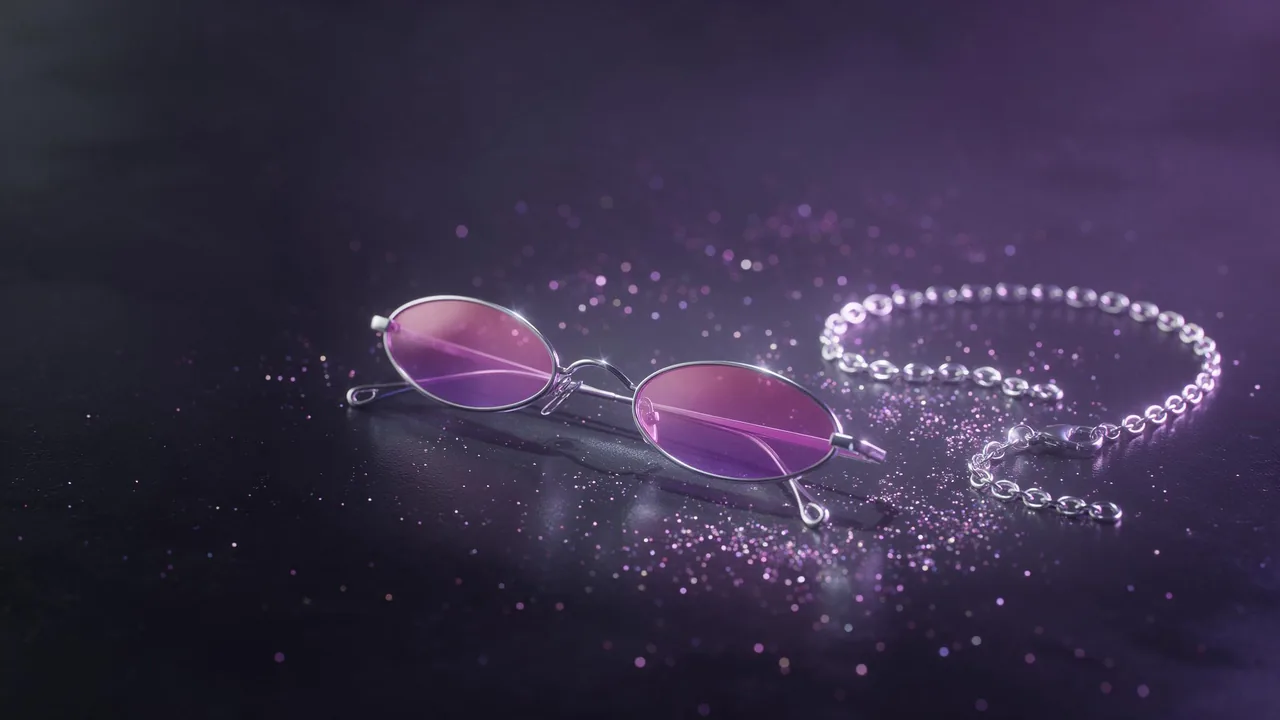
- Tinted lenses: "small oval sunglasses with rose tinted lenses", "blue tinted rimless shields". Say "eyes visible through the tint" if the face has to be readable.
- The supporting cast: baby tee, butterfly clips, a tiny shoulder bag, a rhinestone choker, frosted lip gloss, platform flip-flops, velour tracksuit.
The five looks
A sequence works best when each look pushes one material to the front and keeps the rest quiet. Here is Odile's:
- Chrome: a mirror-silver halter top, low-rise black flared trousers, a wide silver chain belt, small oval sunglasses with violet lenses. Flash against a white wall, hard shadow behind her.
- Glitter: a pale blue glitter knit baby tee, a denim mini skirt, holographic glitter on the eyelids, butterfly clips in the platinum bob. Shot on a staircase at night, flash only.
- Low-rise denim: washed low-rise flared jeans with a studded belt, a white tank, a tiny satin shoulder bag. In the back seat of a car, flash on her, street lights blurred behind.
- Tracksuit: a pink velour zip tracksuit, rose tinted rimless shields pushed up on her head, platform trainers. A convenience store aisle, mixed fluorescent light and flash.
- The night look: a liquid silver slip dress, a rhinestone choker, frosted lip gloss, the violet sunglasses back on. A dance floor, flash freezing her mid-turn, coloured lights smeared behind.
Early 2000s party photograph of a fictional adult woman named Odile, mid-twenties, sharp platinum bob, dark brows, a small gap between her front teeth, laughing. She wears a mirror-silver halter top, low-rise black flared trousers with a wide silver chain belt, and small oval sunglasses with violet tinted lenses, her eyes visible through the tint. Direct on-camera flash from a compact digital camera: bright flat light on her, the flash reflected in the chrome, a hard dark shadow on the white wall behind her. Slightly tilted framing, a little soft at the corners. 4:5.Start look one in a text-to-image model such as FLUX 3 text-to-image and roll it until the face is one you want to keep for all five. Everything after that is editing, not generating.
One face, five looks: reference-image editing
Write five separate prompts and you get five cousins. The fix is to stop describing Odile and start showing her. Pick the best frame of look one, then send it as the reference to an edit model like Nano Banana 2.1 edit and describe only what changes.
Keep the woman from the reference image exactly: her face, the gap in her front teeth, her platinum bob and her brows. Change her outfit to a pink velour zip tracksuit and rose tinted rimless sunglasses pushed up on her head, and place her in a convenience store aisle at night. Same direct on-camera flash look, hard shadow behind her on the shelves. 4:5.Check before you post
- The face: the tooth gap and the brow shape are your proof. If either has gone, redo the edit from the original frame.
- The chrome: it should show the flash and a smeared room. If it is flat grey, ask again for reflections.
- The rise: low-rise creeping back up to a modern waist is the most common drift. Put the rise in every edit prompt.
- The lenses: tinted glasses can swallow the eyes or bend into goggles. Ask for the eyes to stay visible.
- Stray text: a camera, a car dashboard or a shop shelf invites invented labels. Crop them or ask for no writing.
Edits drift less than fresh prompts, but they still drift, especially in hands, earrings and small hair clips. Look at every frame at full size before you call the set done. Every render shows its price before it runs, so test a look cheaply and spend on the keepers. Compare models on the models page and start the set in the studio. Keep Odile and anyone like her fictional: a generated character of legal age, never a photo of a real person.
Questions
Why does my Y2K outfit still look modern?
Usually it is the light. Ask for a direct on-camera flash from an early 2000s compact camera, with a hard shadow behind the subject, and name the rise of the trousers so it does not drift up.
How do I keep the same model across five looks?
Generate one frame you like, then make every other look as an edit of that frame with a reference-image edit model, changing only the clothes and the setting. Edit from the original each time, not from the last edit.
Why does my chrome look like grey plastic?
Metal only reads as metal when it reflects something. Ask for the flash and the room reflected in the chrome, and keep the surrounding clothes matte so the chrome is the one shiny piece.